It’s gratifying to see some simple, but effective principles on distance running getting treatment in the press these days, especially in articles like this one in the Times. I read Chi Running years ago and was fired up about it at the time. I brought several of the routines from the book into drills for my Cross Country team. But it didn’t really change my own running very much. That didn’t happen until a dramatic narrative form of the same lessons in Born to Run brought the material home to me. That got me thinking about what it takes to change and to help others change. Which is another way of saying it got me thinking about what it takes to do good teaching/coaching.

These “new” ideas on running have helped me a great deal, but they’re really very simple: forefoot strike, engaged core, tall posture. I wrote about them in an earlier entry.  I think I’ve known, taught and practiced them to some degree for a long time. But I don’t think I really “got it” and implemented the knowledge until recently.

What is as interesting to me as the techniques themselves–the “content” of the lesson if you will–is the pedagogy: the challenge of how to help others actually adopt new concepts and practices. It’s counter-intuitive. This is such simple stuff that we ought to be able to read it, get it and apply it. In practice it doesn’t work that way.

Take these new running techniques, the “barefoot craze” stuff.  People hear the key points and they think they get it. They go out to try it and get hurt. Or they get discouraged by how hard it is to tell if they are doing it right.  Or by how hard they still have to work even when they do get it right.

They need a coach not only to teach the material and check to see if they get it right, but just as much to help them find their place in the story of where they are going and why. They need a teacher to provide the external motivation until the deeper, habitual practice and internal motivation are fixed in place. They need someone to shore up their confidence– their faith–they can get there.

In my case, the sheer repetition of the lesson from many sources down through they years, beginning with my own high school coach 40 years ago and ending with Chris Mc Dougal’s powerful story of the world’s greatest distance runners was finally enough to get me there. Thankfully, there are many lessons beyond how to run that have come along with that one. Here’s hoping there are still coaches and teachers out there for me to help me with the next lessons I can’t afford to wait so long to learn.

Posted by: cctracker | June 20, 2012

Truth-Bearing Riffs in Keith Haring Glyphs

Once a year in the “Postmodernity” unit of my Humanities course,  I give my students a passing glimpse of the art of Keith Haring. He gets under their skin.  They’re curious, engaged, unsettled.

They ask me questions about Haring and his work. What does it mean? What’s he trying to say? Where did he get these ideas? Since I use the images to capture the issues and spirit of the Postmodern era rather than to explore the art itself, I didn’t have any answers. I hadn’t done my homework. I could tell that his basic vocabulary was based on graffiti, but that was about all I had.

A story on Haring in the  NY Times bailed me out. Take a look at it here.  Ted Loos’ commentary  on the Haring exhibit at the Brooklyn Museum gave me my first real look under the surface of his stylized scrawling and the poppy, playful glyphs that caught me the first time I saw them, as they did my students. Reading the article was a confirmation of how great art often emerges not only from hard labor, but from deep reflection, even if neither are immediately obvious on the surface that catches the eye.

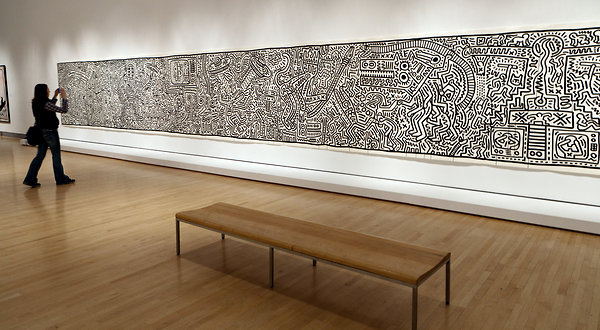
Take this piece, for example.

Haring created it in 1983 at the age of 25. The canvas is 30 feet long, the entire surface crammed with designs and pictograms in black and white.  As the article reveals, Haring labored for months over images like these to find satisfying mini-compositions within the whole so that the eye would be pleased and engaged from one end to the other. He formulated a set of aesthetic rules and principles to capture what worked and what didn’t.

But at a deeper level he was telling us a story. He was prophesying. Just as my students intuitively guessed, he was trying to tell us something. If his rules for good design were complicated, his rules for saying what he meant by it all were positively byzantine. He spoke in code, inventing a hippie alphabet of English letters and words. He even went to the trouble of setting intentional roadblocks for translators who might come along one day to try to read his mind. Perhaps he understood that the soul–especially his own– ought to be shrouded in mystery. That anything we utter that reaches for the depths of meaning and experience ought to take time to uncover since only with long engagement and the passing of time can truths like these be truly absorbed.

As I’ve said I’m a rank amateur,  so much of what he might have been trying to say is lost on me and will probably remain so, just as the nuances of ten-thousand year-old North-african symbols carved in stone will never yield for us the nuances they would have communicated even to children of their day.

Nevertheless, as the article points out, we are still close enough to Haring’s day that much of his message is there–right on the surface– for us to read… and to ponder.

On the surface, Haring’s life tells us a familiar story: a gay social social activist working in the 80’s, takes his inspiration from the streets and dies of AIDS by 1990.

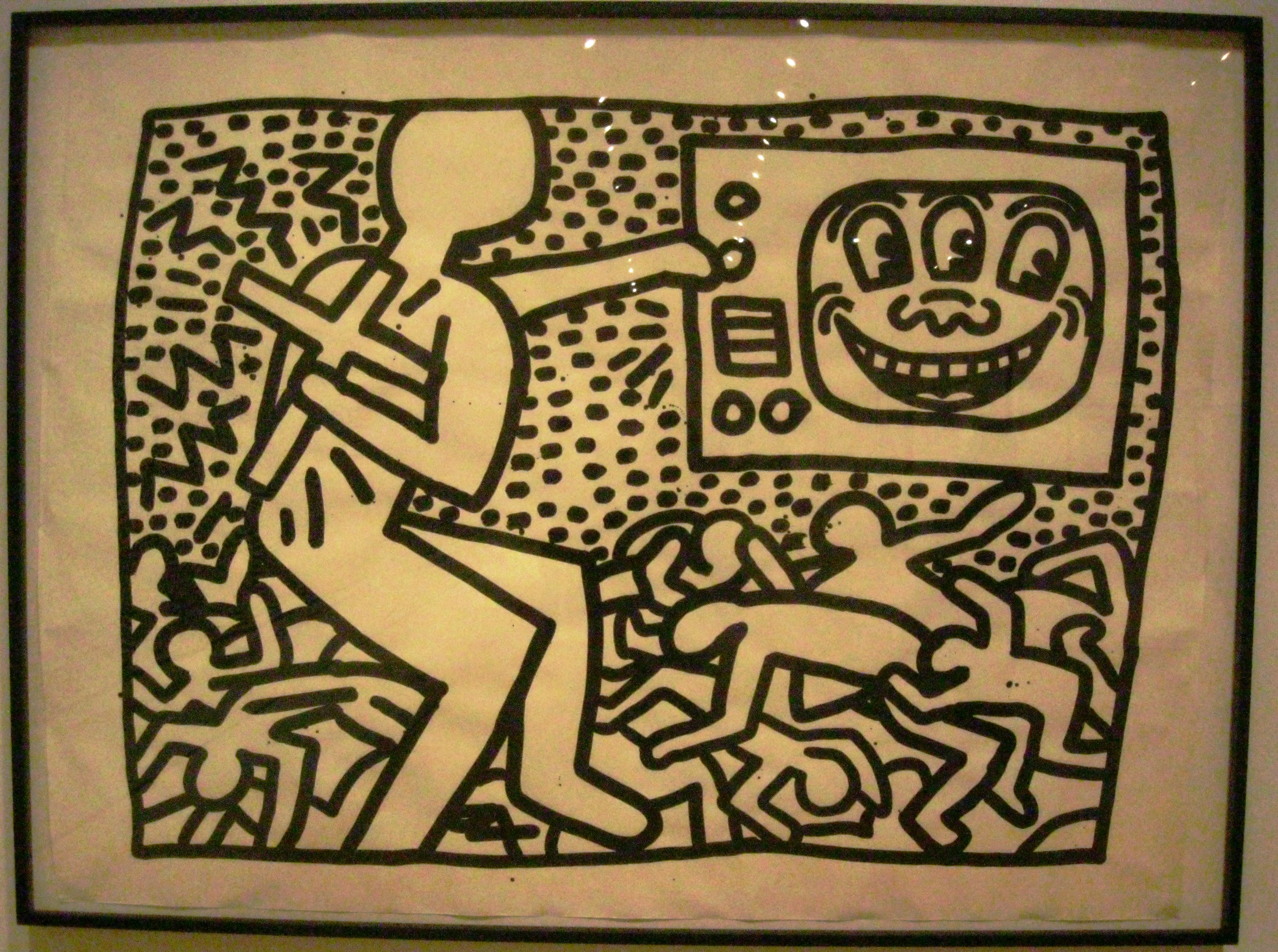
But underneath, Haring’s art still carries a thousand hidden messages. He is still telling us stories we may need to hear as we  confront the increasingly disorienting post-modern political, cultural and religious context of our times. Despite our technological sophistication and fractured, over-stimulated  consciousness, we are still Homo Sapiens, gazing at the walls of our caves with a inner spirit–an elan– that hungers for words or pictures from prophet story-tellers. “What does it mean? How shall we live?” One of Harings recurring images–one that the critics say points close to the heart of what Haring believed ought to anchor human values–is what he called “The Radiant Christ:”

Image at keith-haring-100a.blogspot.com

Haring believed that the message of Jesus challenged us never to forget the poor. This image convinces me he was also aware of the so-called “conservative” message that the value of every human life is non-negotiable.

I’m working on a talk I have to give next month  titled: “Obstacles from Technology to the Personal and Spiritual Development  of Adolescents.” Considering the way Haring’s work spoke to me and my students so powerfully, I’m thinking of including images like this to capture the magnitude of the challenge we face in trying to keep our screens from devouring our spirits.

Image at ritournelleblog.com

Posted by: cctracker | June 18, 2012

Least Tern, Great Karma

Photo at Stltoday.com

Global warming and rising carbon emissions make it clear that we are a long way from the global cooperation we’ll need to tackle the world’s biggest problems. Saving the planet, at least in an ecological sense, won’t happen without national and international policies with real teeth.

Meanwhile though, we have to grab all the good karma we can from things people are doing in their own backyards–or in this case on their own little home-made islands.

This piece in the Post Dispatch was such a little package of good karma for me. Not only because it was a positive story on the environment, but because it captured something of the “spiritual” energy I believe it will take to actually save the planet… and to further ourselves as a species.

Thanks to the Endangered Species Act, the Interior Least Tern, the Pallid Sturgeon and the Piping Plover are all protected. That means we’re required to protect their habitat right here in River City. The story in the Post gives us a glimpse of the work the Army Corps of Engineers–and one particular Corps biologist– are doing to save the Least Tern.

Least Terns are incredibly agile fliers, marvels of nature’s avionics. But they’re vulnerable. About the size of robins, they feed on small fish and lay their eggs on beaches. People on the river disturb breeding and destroy nests. Raccoons, possums, rodents and larger birds eat their young. But the greatest threat they face by far is the approach we still take to managing our great rivers at the dawn of the 21st century: damming, channelization river bank industrialization and gambling casinos.

So the Corps are building little floating islands for them.

Photo at Stltoday.com

They lash old pontoon barges together, cover them with a few inches of sand, plant some driftwood and decoys and  hope it looks like home. Ben McGuire, a wildlife biologist with the  Corps, waits for the birds to make nests and lay eggs, then watches for predators like Blue Herons on remote cameras. He hopes to band chicks when they hatch before they leave the nest. He’d like to find out how many of them return to nest here again.

I was moved by this story and took a few days to think about why.

Part of it, certainly, is the very fact that this a Corps of Engineers Project. One of the organizations most responsible for our disastrous approach to river management is on the other side of the equation in this case.

But even more it was the simple idea that someone was out there on a summer day doing this improvised, no doubt rather tedious work, on behalf of a few birds. There is a whole school of Buddhist practice built around the idea that attending to a simple task with focal awareness carries spiritual power.

Photo at www2.newsadvance.com

How much more grace comes from work that sends more Terns into the air to wheel and dart and dive, skimming silver minnows from the muscular surface of the greatest river on the continent?

I have no idea what McGuire thinks of his job or what he would say about the meaning of his work, but I’ve found that people doing careful, steady work like this often have a kind of peace and strength that seems more and more real to me the older I get.

The Endangered Species Act takes a lot of abuse these days. So many see it as an attack on individual livelihoods, a threat to a region’s economic future. We’re all held hostage by “big government” they say and for what? A few ultimately meaningless species whose fragile hold on existence is at odds with the practical need for progress and growth. Plenty of critters do just fine living with us on our terms. And there will always be National Parks and nature reserves for most of the rest.

You may or may not like the politics of the act, but it is a direct challenge to that kind of thinking. The world is no theme park. It won’t be managed one manicured, faux-wild patch at a time while the rest of the environment is regarded as a commodity. The act rests on a simple, but overwhelmingly important truth: all things are connected. When one species teeters on the brink, it is statement about millions of filaments tying it to everything around it. Cultivate attentiveness to one species–and take action to save it–and you do something far deeper and more powerful than we can appreciate for the web that surrounds it, and ourselves. Not a bad concrete way of thinking about karma.

—–

According to the story in the Post, The Interior Least Tern population is now about 15,000, double what it was in 1995.  But it might yet disappear. It’s the fourth year of this five-year island experiment. Who knows whether it will work? Maybe McGuire will have moved to another project by next year. Maybe the Mississippi and many of America’s other great rivers, despite hopeful signs, are still dying. Maybe Greenland will melt. But I feel the responsibility to hope that these things are not inevitable. And to channel all the good karma I can find into my own humble labors.

Are We Living in Sensory Overload or Sensory Poverty? – NYTimes.com.

Here’s a piece that speaks to an issue I  think about every day. I find my high school  students very receptive to Ackerman’s message, despite the dismissive comments of some of the young people who responded. They confirm her belief that we are crossing a new threshold of detachment from direct experience. They feel in their bones that something is wrong.

Educators, mentors and coaches have always taught  ‘presence’ to young people in hundreds of ways, in every discipline and activity. Perhaps now, because the stakes are higher, we’ll see a new outpouring of energy and creativity dedicated to teaching awareness. Perhaps that effort will remind educators and adults that the lesson must begin with our own renewed practice.

Photo James Burton

Posted by: cctracker | June 8, 2012

Thank you, Mr. Bradbury

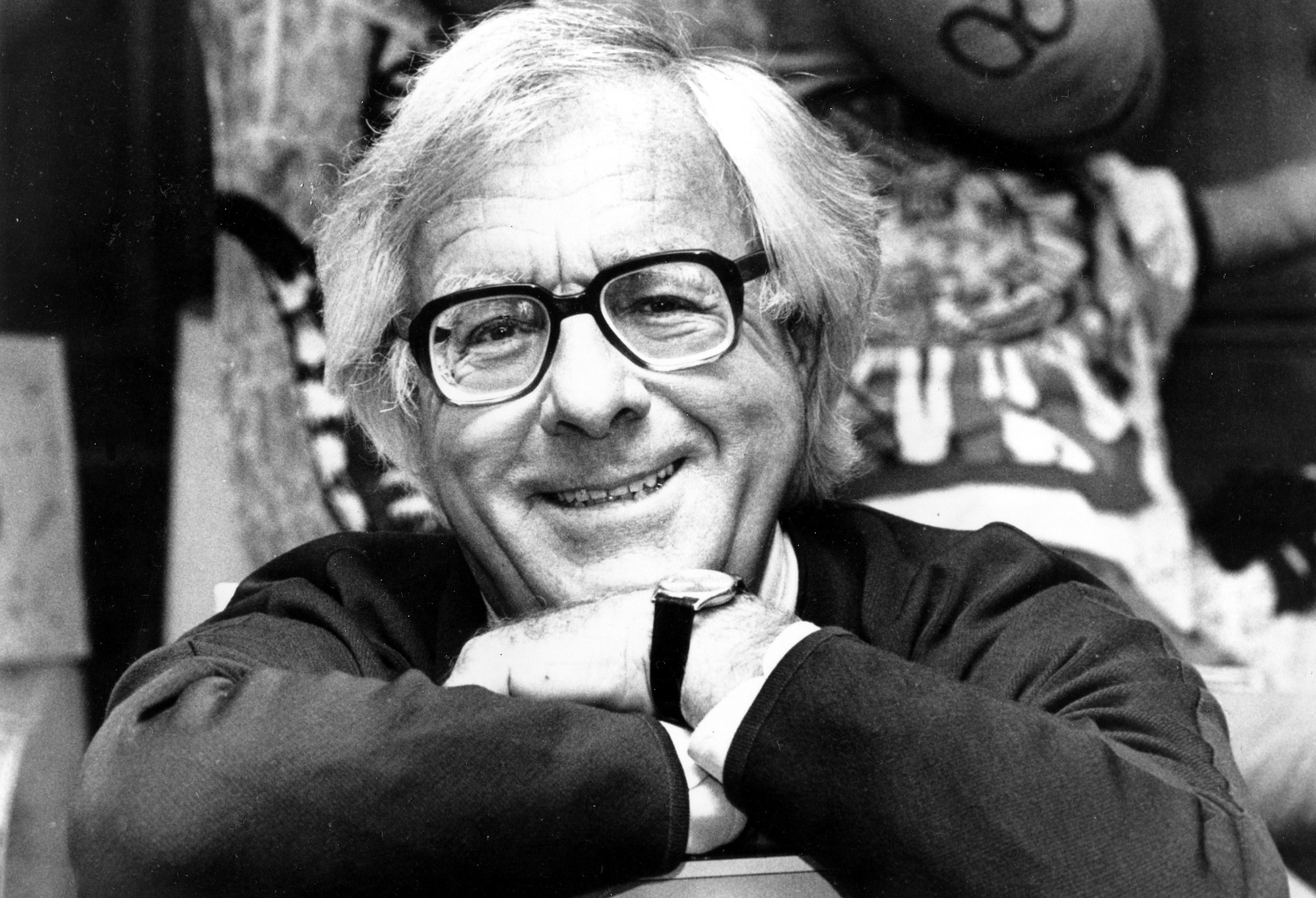
More than anyone else, Ray Bradbury is responsible for my having fallen in love with books. For that alone I am more grateful than I can say.

But he did something else for me that was every bit as vital. I’ve been trying to figure out how to express it in these days of reflection on his passing. The trouble is I’d have to be Ray Bradbury to capture it.  I want to try here, anyway.

Reading Ray Bradbury as a boy set the music of my soul in the key of meaning and romance.

I don’t know which of his stories I read first. It may have been one in R is for Rocket. But as soon as I was inside a world he created, something stirred inside. It wasn’t a response to astonishing landscapes on other worlds. Or characters caught in a spiraling web of weird events. Or the occasional monster.

It was a felt sense that something important, something extraordinary, something full of undisclosed meaning was about to be revealed. Events charged with a mysterious significance were unfolding for his characters, moving in an urgent direction. When the moment came, they might be horrified. They might be agape in wonder. They might be saved in the nick of time. They might be disemboweled.

But whatever happened, I felt as if I’d arrived somewhere I’d never been, somewhere important. I’d seen something I needed to remember. Reading Bradbury, I developed an expectation, an appetite, for that moment of disclosure:  Where were these events leading?  What was the truth behind appearances? What horrible or holy secret lay under the surface of a pond in summer or in the electrifying recesses of the mind?  I turned the page and started another story and he whirled me along toward the next revelation.

I’ve read that he was fascinated with magicians and magic as a boy. His standard slight-of-hand for producing this heightened state of expectation in me involved two basic elements: 1) a clever plot idea or conceit to drive the narrative forward and 2) a philosophical or metaphysical truth– almost never explicitly named– to reveal. Here are some examples from his stories. I didn’t have to go back and re-read these. They were still there waiting for me in my memory as soon as I turned back the pages to find them.

All Summer in a Day

The truth: The horror and blindness of human cruelty.

The device: On a planet where it always rains, school children don’t believe a girl who rapturously describes sunny days. She saw them long ago on another world  longs for them terribly. When a once-in-a-life-time sunny day is rumored to be coming, the kids lock the know-it-all in a closet and forget about her.  Until the day has come and gone.

Frost and Fire

Dreams are worth the risk and sacrifice.

Beings have been stranded for generations on a planet where exposure to sun violently accelerates the pace of life. They live in caves, venturing out to hunt and gather. Even at that entire lifetimes are lived in a single week.  They dare not risk the years it would cost to reach a nearby space ship that might provide escape to life as it should be. A journey that took half their lives might only bring them to a dead and useless hulk. A dreamer comes along to challenge their private greed and communal fear.

A Sound of Thunder

The future rests on every choice made in the present.

It’s election time in an era of peace and plenty threatened by building clouds of violence and decay. One candidate advocates facing the truth and working together to face the issues, the other offers fascist rhetoric. The right man has just won. Time machines offer the wealthy a passage back in time for the ultimate sport: shooting a dinosaur just before it would have died anyway. Despite elaborate precautions to protect the present by disturbing nothing in the past, a hunter falls off a walkway and steps on a butterfly. When he returns to the present signs are spelled just a bit differently. And the  fascist has won.

The Veldt

Ordinary people, harmless and innocent though they may appear, can be monsters.

Clueless and distracted parents have indulged their children with the very latest in video games: a room that allows the gamer to enter an immersive and fully realized environment. They begin to face up to the truth that their kids need their attention.. and some reigning in. A contest of wills ensues and each time the parents enter the game to call the children home they are unsettled by the harsh African savannah they’ve built as a playground. What do they do all day in a place where lions feed on carcasses in the distance?  They resolve to shut the damn thing off, but when they go into get them for the last time the children are hiding out in the tall grass. Then come the lions.

Skeleton

Our neuroses and obsessions can be our undoing, especially when predators can exploit them.

A man obsessed with his aches and pains finds a strange, yet anxious relief in the treatments of a mysterious doctor who tells him he has a “skeletal” problem. He becomes more and more dependent on the treatments–which require more and more strenuous tugging on his bones– and less and less trusting of the man behind the cure. His desperation and fear rise together until the doctor proposes a final cure, an ultimate release from the underlying problem.  On the day of the last treatment his wife can’t find him. She opens his office door to find a giant jellyfish lying on the floor. It calls her by name.

Night Call, Collect (from The Martian Chronicles)

While we can behold the mystery of time passing and nevertheless coherently remain ourselves from moment to moment, who we once were and who we are now are not the same person.

A man is the last living soul on a planet. His sense of time begins to warp. He looks to the future and knows that another man is out there, by himself, living just as real a life as he is now. He is young. That man is old. He enjoys his youth but hates his isolation. There is only one other person he can talk to who will hear…or understand. It occurs to him that he can call him now and record the conversations so that his only partner will get them in the future. At first the calls are tentative and cordial. Then intimate. But as time advances and he realizes there is no stopping it’s inevitable march toward age and decrepitude, a dark impulse rises within him. He begins to mock and curse the future he cannot prevent and cling to the present, immortalized in the telephone calls. He will still be young and vital when the old man gets the calls. Eventually his youthful anger and spiritual resistance fades. He forgets he made the calls. Wisdom and peace grow slowly within him. He accepts his life. Then, one day, the phone rings.

This is the one I probably return to most often. The calls have started.

20 years ago I had wonderful chance to express my gratitude in person. I came to a book-signing with my oldest son. There was a long line, but I explained to him that this man was important for me: he’d taught me to love reading. I don’t think my oldest had read any of his stories yet, but he was a voracious reader and he was willing to be patient.

At last the moment came. I had so much I wanted to say so quickly. It came out something like: “This is my son. He loves to read. If not for you I might never have learned to love reading and we wouldn’t be standing here together.” He couldn’t have been more gracious. He paused, looked at my boy. He lingered with us. Asked my son some questions about what he was reading. I handed him the copy of his Quicker Than the Eye I’d bought, already feeling he’d given us too much time. He signed it and penned good wishes to my son. The other day when Ray Bradbury died, a text message from my son was how I got the news.

And so, not only for a life-time of reading, but for a life-long inclination to read, in the world around us, the great mysteries and romances of the world within, thank-you, Mr. Bradbury.

Posted by: cctracker | June 6, 2012

Love Alone Is Credible

I’ve been reading a book with this title by theologian Hans Urs Von Balthasar for the last year or so.

It’s a dense, philosophical work and I’ve read it a few paragraphs at a time, marking it  heavily as I go. I’m nearly finished. But even after a close read I can’t easily call to mind many of the book’s central ideas without going back to the text.  Another reminder about the limitations we seem to have for retaining a hold on the abstract. I’m sure I could spool out most of the plot if it had been a novel. More on that point in a moment.

Nevertheless, I’ve found that the mere title of the book has fruitfully focussed my mind on underlying, abstract questions I’ve been asking for many years:

To what  do we owe a profession of faith in this life?

What is worthy of being believed?

What invites us, even obliges us, to be at its service to a higher degree than to our own immediate needs or desires?

I’ve been raised and trained to regard “God” as the answer to these questions. But that word, so often, seems to beg the question. Reading Von Balthasar and thinking about this title has been an occasion to ask what it really means not only to say that “God is Love” but what it means to proclaim one’s faith in love.

I’ve not made an entry in this blog for a well over a month. It would be easy to say  it was the frenetic pace of end-of-the year activities at school, college boys moving back home,  delayed home and garden projects or weathering a bout of the stomach flu in our household.

The truth is I had plenty of time to write and ample inspiration on worthy topics. I just couldn’t find the energy. I didn’t feel generous. Honestly, I was in a selfish rut. I  found myself wasting time online, fiddling more than usual with my phone, nursing private grievances, feeding petty addictions. From the Sudan to U.S financial markets to crises confronting friends and family, all the news seemed grim. And since some part of my consciousness is always asking the “big” questions of meaning and purpose, there was a faith crisis, too. Didn’t faith in “God” impose the reassuring order and intelligibility I craved on the reality of chaos, ambiguity and overwhelming complexity I actually experienced ?  And more intimately, wasn’t the wishful and spiritual story of “Love” contradicted not only by brutality and depravity in the headlines, but by the fundamentally selfish motivations I could see and feel in those I loved and in myself?

This makes the last month seem dramatic, but it was actually pretty normal.  It was one of those patches of low-level moodiness that are easy to ignore or excuse. It seems I have to learn over and over again that a little honest reflection about what is really going on almost always leads to greater awareness and insight. I usually need some kind of a shock from the outside to get back on track. One of those shocks came from a recent article in the NY Times.

An 18-year old Pashtun girl named Lal Bibi was raped in Afghanistan because a distant cousin had pulled out  of a marriage proposal, disgracing the disappointed bride’s father. The Times told her story this past weekend in the context of the larger story of so-called honor rapes in that country. She was abducted, chained to a wall, beaten and raped repeatedly by members of the offended clan. They believed the wrongs they had suffered had to be redressed. This was a traditional way to gain satisfaction. Her innocence–indeed her total ignorance of the offense–was beside the point.

Photo NY Times

It was hard enough to read how the law, the government and the police failed a young women like Lal Bibi. But it’s difficult even to categorize the emotions I felt when I read how her family now regards her. They, too, believe that these “wrongs” must be redressed. But they feel the burden not only of the sins forced upon their daughter by others but also of the shame that taints her from within and brings disgrace to the family. Her mother spoke for them about the prospect of getting no redress from civil authorities:

“If nobody wants to solve our problem, then they should behead her; we don’t want her.”

Years ago, a remark like this would not only have stirred up feelings of acute sadness, anger and disgust in me, but would have been profoundly disorienting. How could the “sacredness” of familial love fail so horrifically in this situation? Indirectly at least, it threatened my faith in the inherent goodness of human beings, in the universality of Love, in God.

Her family’s love for her before the rape–and even after to some extent–was obvious in the story. Intuitively, we all understand how a mother feels about a daughter. We assign it a place of universal value across cultures. Yes, many mothers fail their daughters and even abuse them terribly, but we put that up to social or psychological dysfunction/disease on the one hand or moral evil on the other.

Except this mother wasn’t pathological. And while I might call her culture “diseased” it is explicitly monotheistic and appears to be functioning naturally. Her cruel indifference isn’t a result of the damage done to the fabric of the family by the dysfunctional violence of Afghani society; it is a personal-cultural-spiritual way of managing violence and has evolved to maintain cultural order and psychological coherence in the world as it is.

Today I can explain this mother’s words about her daughter quite simply: biology. To put it with a little more nuance: reproduction and clan identity are of such critical importance in the way human beings have evolved in a chaotic and threatening world that symbolic cultural practices like these–and the ideas and emotions that go with them–have evolved to protect them. Biology in this case trumps the “natural” loving bond between mother and child–a bond that serves as one of our most powerful metaphors for God’s love. It has an even easier time overcoming the principle of the infinite value and inviolable dignity of human beings outside of one’s own clan, the practical center of God’s message to humanity in the Christian religious tradition.

That brings me back to explaining my bad mood. And to one of the reasons I started this blog: “Spirit in the World.”

Most of the time I’m able to keep the dialogue between material and spiritual approaches to reality going in a way that energizes my enthusiasm for both perspectives. But on occasion I find myself on the ropes in terms of faith. This past month was one of those times. But the story of Lal Bibi and her mother provided the shock of grace rather than doubt. My response to her story was so strong, so immediate, that it put me viscerally back in touch with my faith. I loved her as I read her story. I believed she was entitled to love and compassion even though I could, in a material sense, excuse her mother’s callousness. I can profess a faith in Christ which says that her life is transcendentally beautiful and valuable, that it has an infinite meaning beyond the biological expression of properties working themselves out in her brief moment of history, in her all-too-vulnerable vulnerable flesh. Love, God’s ongoing creation in this world as it is, is unfinished, still evolving. And the story we need to tell one another about God and Love revealed in the world must always be told in the context of unfinished chaos and suffering.

I was thinking about all of this when I recently read a remarkable review by James Santel in the LA Times of  Jonathan Franzen‘s book Farther Away, a collection of his most recent essays. I mentioned at the start of this entry that I might have better remembered Von Balthasar’s theology if it had been written as a novel. I read Franzen’s novel Freedom last year, and while it isn’t theology, it certainly is a story about Love revealing itself amid chaos and suffering. Santel’s wide-ranging essay examines the theme of Love in the novel as well as in this new collection of essays.  Most poignantly, the essay also deals with the relationship between Franzen and his close friend David Foster Wallace. Wallace, a widely acknowledged leader in American Letters and the author of Infinite Jest, committed suicide in September 2008.

Photo at sarahhina.blogspot.com

Santel observes that some of Franzen’s critics may regard his new collection of essays as having gone so far down the road toward a spiritualized approach to Love that  he drifts into a “hollow piety.” I was grateful to read such a phrase. I’m keenly interested  in any widely read work in the humanities that still elicits as much as an offhand reference to traditionally religious language, even in critique. In this case , Santel is honoring the religious dimension of Franzen’s work. Toward the end of the essay, he quotes Franzen in a sentence that has helped me recommit to the value of dialogue between spiritual and material points of reference:

“What love is really about is bottomless empathy, born out of the heart’s revelation that another person is every bit is real as you are.”

This, for me, is a powerful, original and contemporary way of expressing faith in Christ.

Near the end of Von Balthasar’s book, he returns to the central idea undergirding his vast, theological project: the importance of beholding the Transcendent Other. The origin of our life out of nothingness, he says, and the source of our hope as mortal beings facing the looming void of death–however much we are responsible for nurturing the gift in the here and now and laboring to build a hope-filled future–lies beyond ourselves, beyond our efforts. Accepting this, he says, is what it means to believe in God.

But how do we make the existence of “God” believable for a weary, suffering, cynical world? How should we help others–and ourselves–to surrender in the midst of so much suffering to this “Transcendent Other” in faith?

We can only do this work “in Christ,”  which is to say,  as Franzen put it quoting Alice Sebold,  by “getting down in the pit and loving somebody.”

 Hans Urs Von Balthasar captured the same truth in the title of a book that has guided my prayer and reflection for many months.
If we seek to draw anyone, including ourselves,  to faith in a Transcendent God, “Love alone is credible.”

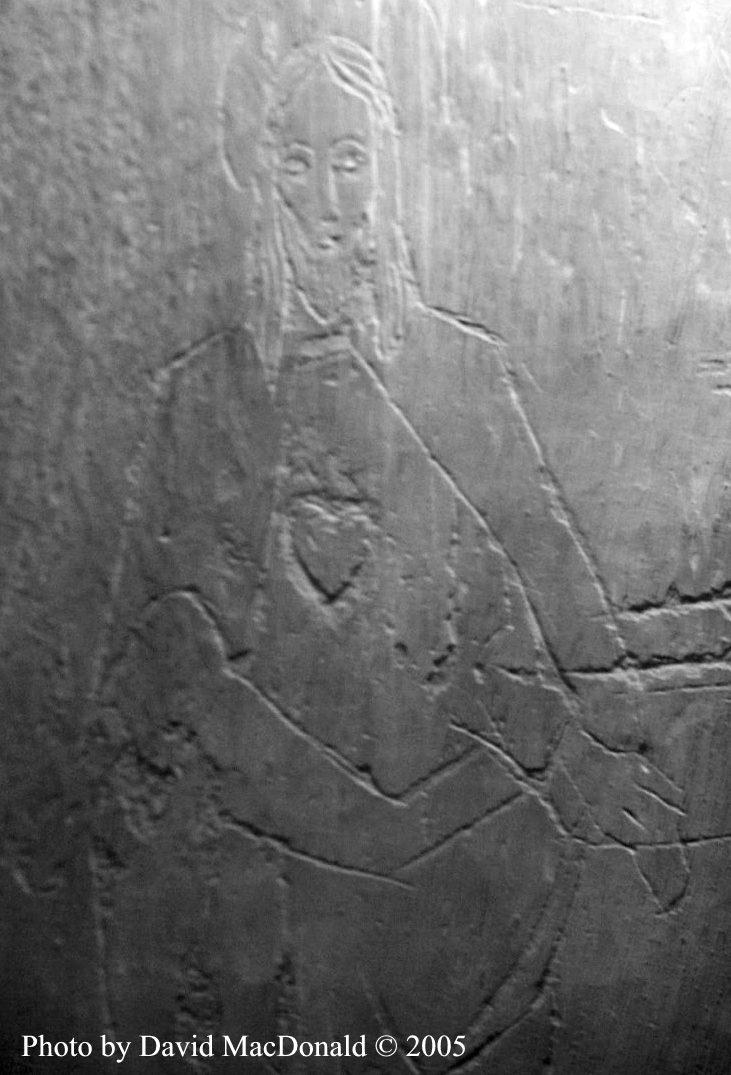
Sacred Heart of Jesus Image carved on a concrete wall at Auschwitz

Posted by: cctracker | April 25, 2012

Wendell Berry, American Hero – NYTimes.com

As a kid I was obsessed  with the fantasy of superheroes. Here’s a testimony to what real, ordinary super-heroism looks like.

Wendell Berry, American Hero – NYTimes.com.


Posted by: cctracker | April 24, 2012

Backyard Walkabout

Photo of Oecophora bractella and House Sparrow eggs at nytimes.com

No matter how many times I’m taught the lesson, I’m surprised over and over again to relearn it.

Abstracted as process, it goes something this:

Look.

See that?

Pay attention.

Closer!

Yes, that.

Now, OBSERVE.

Repeat, everywhere.

Take a look here at a wondrously good New York Times article that reinforces the lesson.

Now I’ll grant that as a science writer on exotic species Carol Kaesuk Yoon is uniquely prepared to absorb this wisdom, but she was in her BACKYARD for goodness sake and the critter was sitting a few inches from her nose in dazzling, iridescent color!

Her story begins with a moth on her kitchen screen. I was schooled in the lesson last summer when a fly caught someone else’s eye.

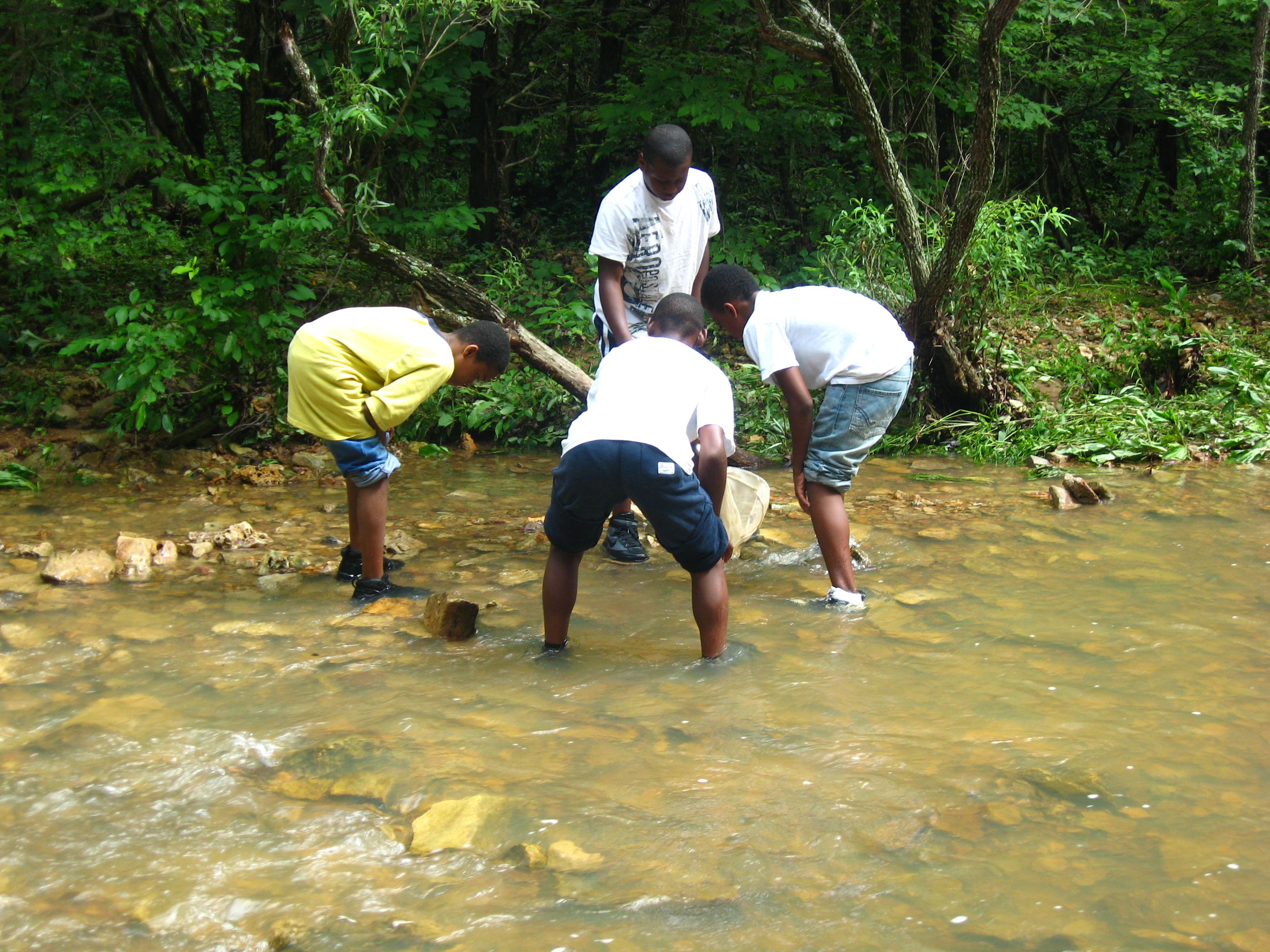
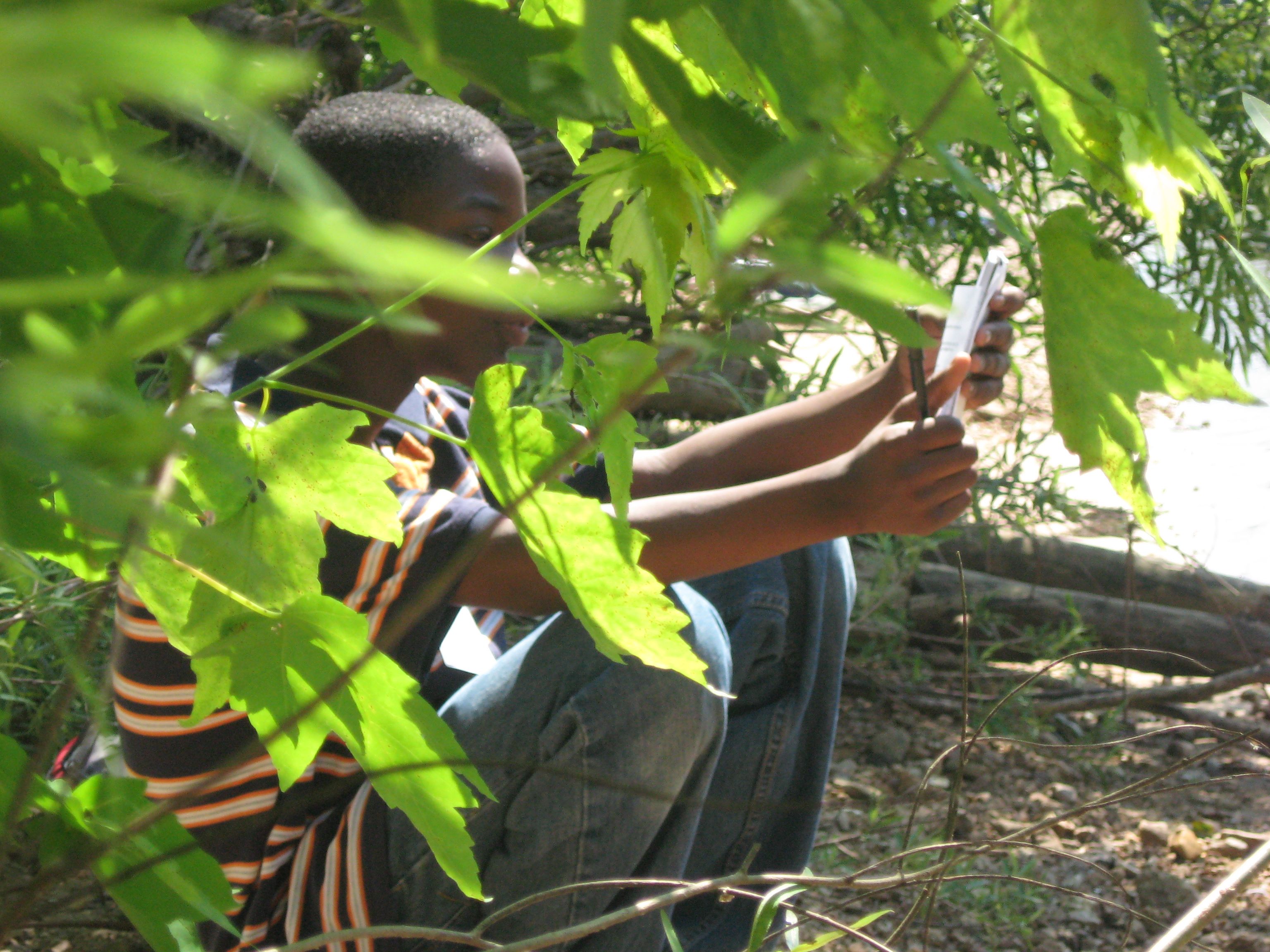
I teach in an outdoor summer program called Walkabout. A “Walkabout” in its Aboriginal Australian context refers to an extended ritual journey in the wilderness for an adolescent male.

Our program is three weeks of classes in reading, writing, art and field biology for 6th grade boys with hiking field

Photo James Burton

trips every other day in the heat of a midwest summer. It’s great fun, but despite the modest scale of the hikes and an experiential emphasis in the classroom, it can be an ordeal for the boys.

We were hiking steeply up hill in full sun.

I walked at the head of the line crunching out rhythmic steps on an unremarkable gravel path at a pace I felt the boys could match until we reached the top. Though “Awareness” is our mantra–the boys are always supposed to be looking for plants and animals of note–the hiking rule is “no complaining.” I was on guard against supposed “sightings” that were really excuses to stop. It was time to teach a little toughness.

“Hey! Look at this!” I didn’t miss a step but shouted back over my shoulder: “Whada’ygot?”

“A big fly!”

“Great! Get a look but let’s keep going!” Clearly a bogus ploy for a rest. We weren’t stopping for a horsefly.

“No, this is a COOL fly!”

Perhaps it was the sincere music in that youthful throat. Maybe it was simply a kind of blind obedience to the mantra. I stopped and turned around.

“Ok, don’t spook it! I’ll get a picture.”

This was a big fly. For a split-second I thought it might be a bumble bee, but I got close enough to confirm that the student had gotten it right. From three or four feet away, the zoom got me a pretty good shot.

The group was already moving on. “Hold up! Let me get to the front.” A few seconds later we were marching up the trail again, the fly forgotten.

Hours later I opened the day’s photos on my computer to prepare for the class the next day and there it was.

Robber Fly-Photo James Burton

I was astounded by the detail the photo had captured: bristled legs like bottle brushes, prominent, menacing, mechanical hooks emerging from the rear of the abdomen, huge oval eyes, orange and yellow hair-like tufts, a humped “backpack” just behind the head and, most terrifying of all even before I discovered its function, a long mouth tube like the barrel of a gun. The beast seemed to me a nightmarish hybrid  of insect and machine, something a nefarious group of military scientists might design one day soon to infiltrate the enemy lair and give the bad guys a lethal bite in the ass.

Turns out this fella’–one of the Robber Flies– doesn’t bite at all. He grabs flying insect prey mid-air with those huge legs, lands somewhere, then injects them with an acidic saliva turning their flesh to digestible goo which he then slurps back up through his mouth tube.  The students went crazy the next day. I had tried to find the exact species in the field guides so I could give them the scientific name, but insects are the hardest creatures we study in the course: so many species in such variety that all you can usually do is get the name of somebody in the family.

Though I didn’t find him in my backyard, he’s probably out there every summer terrorizing my moth population.  And that’s Yoon’s point in her NY Times piece: “So Much Life on a Little Patch of Earth.” The fact that the moth she found had never been seen in North America was news, but her main point is more fundamental: We ought always to be looking. We ought to be in awe of the astonishing variety, complexity and interconnection of life around us. Inspired by the moth, she tries to document every species of life on her own small planetary plot:

“Our unimpressive lawn became a kaleidoscope of mysteries, just one square foot of it boasting multiple species of grasses, one species of dandelion, countless other unknown plants that quickly came and went, and no end of insects, algae, mosses, worms, bacteria and fungi.

Every beam of slanting light, every breath of wind, every flitter of movement revealed something unseen. A droplet of rain splashed on the deck, a potential marvel of aquatic life. A newly noticed stain on the fence proved to be a burgeoning lichen. A squirrel ran into the yard and paused to scratch itself, prompting Merrill to yell out: “Squirrel fleas! New yard species!”

Soon, she is overwhelmed:

“I wish I could give you a bottom-line species count, but I can’t. Living organisms are reliably, inspiringly unpredictable, as any birdwatcher can attest; in years of watching, we have seen many species only once, so it is very likely we have missed many more. And though we are good at spotting birds and insects, we are nearly plant-blind, so who can say what botanical change has been afoot here? The same is true for the many, many microscopic things we literally cannot see.”

She concludes:

“For those, like children, with eyes open wide, rarities can abound. On any given day, of course, you’re not likely to spot an unexpected guest. But one day it will happen. While you slice a grapefruit or fold laundry or sit at the computer, something unbelievable will be creeping or flittering through your life. Look for it, just in case.”

Every summer I testify again–even preach–about the faith to a new set of fresh faces : “Awareness!”

Photo James Burton

But the truth is, I doubt. And other times I just don’t want to bother: we’ve got to keep marching, I sometimes tell myself.

And each year its the students who stop me. Their musical voices ring out: “Hey, look!”

Their 20 pairs of eyes rove the landscape and never fail to find something riveting to look at, to believe in.

And it is so important that I do stop with them to take a look, to marvel. Because my real hope is to send them back to their backyards, where they’ll live out most of their lives, in the spirit of “Walkabout.”

And I need to have that same spirit, find that same faith, in my own backyard. If I can’t find it there I am lost indeed.

Photo James Burton

Posted by: cctracker | April 22, 2012

Ridin’ the Bus, Keepin’ It Real

It was “Care Free/Car Free Day” at school last Thursday.

Some students walked in, starting out before dawn. Many rode bikes. Those near a line took the light rail. My wife has been suggesting for years that I try our local option for public transportation, so I caught the bus.

Check out this great essay by Frank Kovarik  about the layers of history and culture on my route.

7:05 a.m.

My wife offered to give me a ride to the bus stop on her way to work. Hopping out with my back pack, I realized I had no money.

“Here” she said, handing me a $20, justifiably a little annoyed at my spaciness. “You’ll have to walk somewhere to get change. What time does the bus come?”

I had no idea.

“You didn’t check on-line?” she asked, frustration rising.

“The site was pretty confusing. I’m sure one will come along soon enough.”

There were cars behind us and she was going to be late if she waited to see what became of me.

“Go ahead, I’m good.”

With a skeptical “OK then, good luck!” she turned her attention to her own oncoming day. The door closed with a “clunk” of finality and her car pulled away.

What came next was one of those strange moments of dislocation you have when your car breaks down. You stand on the side of the road with oblivious traffic going by. Or maybe a shock or misfortune pulls you out of your routine and onto life’s sidelines. Suddenly, you’re watching everyone else going about their normal business. Your mind mutters at you in existential nervousness: “Who are these people and where are they all going? What do they think of me standing here? Do they even notice? And where am I going, anyway? How will I ever get there?”

Fortunately, another more buoyant and literary voice in my head also had me feeling like Cary Grant waiting for George Kaplan in “North By Northwest.” It said something like: “This is interesting. I have no change. Nothing is open on this stretch of road. This story could go in any number of directions. I wonder how this day will end?”

7:12 a.m. I had an important meeting at 8:05. I guessed the trip to be about 11 miles. I started my commute walking east.

Here’s how the rest of the day went “by the numbers:”

200 meters down the road was a tiny, very lonely looking cinder block building. I assumed it was an abandoned husk. “Open” said the sign in the window and in painted lettering above the door: “Trog’s.”

I knew immediately the building reminded me of something but I couldn’t say what. A small, old gentleman was inside behind an ancient counter. Not a single product to buy in sight, so I just had to ask for the change. “What’ll it be?” he asked. I didn’t understand the question. “The bills. What do you want?” Suddenly realizing I didn’t even know what the fare was, I asked for a 10, a 5 and  5 one’s. He handed it over. I thanked him and walked back out to the road to stand at the nearest bus stop sign.

Edward Hopper's "Gas"

Looking back downhill at the shop, I saw him walk slowly out to the old-style pumps in front. He got out a rag and began wiping down the concrete posts guarding the gas. That’s when I knew where I’d seen the building–and its proprietor–before.

My eyes were back on the road, looking west for the bus. There was little else to do but stare at the pavement, so I did. As soon as my eyes found a patch of it with new grass growing up through the cracks, it felt so familiar. As a kid I’d stared in boredom at pavement thousands of times. It had been a very long time, but wherever and however such a specific category of experience is stored in memory, it came over me like physical sensation. I was sweating just a bit already on a warm morning. My limbs were loose and strange and my skin was breathing. It was odd to be wearing a tie.

When the phone buzzed in my pocket I was still elsewhere and it took a second or two for me to think of what it was.

“Hey, it’s me. I checked. Your bus is #57. It comes at 7:33.  It’s two bucks. Ok? Bye Bye.” I was being taken care of. It happened that way all day.

7:38 a.m. The bus arrived.

I climbed in, slipped bills in awkwardly as directed by the worn illustration on the stainless steel fare counter: George-up-crown-facing-east. I settled into a seat. There were 13 of us aboard,  seating capacity about 46. A fairly late bus for real working people. The passengers talked in familiar, tired, morning-work-day tones, the folks closest to me about Sea Monkeys: those tiny, shrimp-like creatures that come

Image at The Comic Book Catacombs

powdered in a bag by mail. A guy said to his skeptical seat mate: “No, I’m serious. You just put this stuff in water and you see these tiny monkeys swimming around.” She wasn’t convinced and he couldn’t explain it any further. Guy had probably been a Boy Scout. And she had probably never seen a copy of  “Boy’s Life.”

Some folks just stared into their cell phones. I wondered if in 20 years anyone would be talking to someone sitting next to them when they could be tuned in to almost anything anywhere inside their heads. Would the elites be tuning in on custom “feeds” they bought and built for themselves to maximize their opportunities?  Would regular Joe’s and Jane’s have commercial streams of sights and sounds beamed into their heads as they went from Rockhill to Brentwood to Maplewood?

This route is a straight shot: a single corridor extending from the near county well into the city, through 5 gritty, established inner-ring suburban municipalities. The bus pulled into a light rail connection station at one of them and sat there for 10 minutes. The driver reassured me I could stay aboard. I asked twice just to be sure.

7:55 a.m. We got going again and I called in to let them know I’d be late for the meeting.

8:23 a.m.  I stepped down onto the pavement a few blocks from school. By 8:33 I was at the conference table, blaming the bus. There were knowing snickers, eyes rolling all around. We were all mocking the bus. But I felt guilty doing it. The trip had felt so real.

It was a full day of meetings, paper and projects, but my class met in the middle of it all and we were talking numbers. Were they real or just human invention? Did they reflect the universe or the mind? Was the order they helped us discern really there in the universe as testimony to God or were we imposing the order on impossible complexity and fundamental chaos? The previous day we’d had a guest speaker on infinity. His class felt to me like the presentation of a 40-minute zen koan. He had us count, group, sort and subdivide infinity and then, when we’d worn ourselves out, come back to it as something that couldn’t be grasped. He ended with a meditation on the Eucharist: the infinite contained in a wafer of bread. We ended our unit on my bus-travel-day suggesting that maybe math didn’t say as much about God by means of what was out there as much as it pointed to the infinite–and so to God–in here. Wasn’t that another way of saying what we believe about the transcendental nature of human beings, what we mean by faith in Christ?

5:00 p.m. Leaving my office and out into the alley behind school.

Bi-State Kiosk Poster

It was a 5-minute walk back to the bus stop, but this time I was in no hurry. I stepped out of the sun into the kiosk at the stop. A young boy about 5 years old sat on the bench with his young mother. He was eating chips and drinking a soda. She sat there staring straight ahead or at her cell phone. The boy wanted to talk.

“Mom, what’s 10 x 10?”

“100. Why are you asking me that?”

“Just something I was thinking about.” I could see this was a very clever kid, his face and voice alive with constantly changing expression and musical intonations.

“How about 20 x 20?” he sang out next. “400” she replied, still staring straight ahead.

“30 x 30?” She hesitated for just a second. “900.”

40 x 40?” She smiled and looked over at him now. “What do I look like, a calculator?” “1600.”

He giggled now, knowing he had her going. “50 x 50?”

“Now that’s enough!”  she said laughing herself.

He tried one more time:”60 x 60?” She looked like she was thinking about this one, then scolded: “I told you I’m not a human calculator!”

“I wish I was a human calculator!” he said brightly. I couldn’t resist him anymore.

“I recognize a smart boy when I see one!” I said. That got his mom and I talking.

She turned my way and asked if this bus was usually on time. One trip and someone actually thought I was a veteran! She explained that she had a 5:30 doctor’s appointment at a clinic in 10 minutes.

“Buses are always late and they think they can just keep raising the rates on us.”

The boy jumped in: “You going to be late, Mom?”

“No, you are the one who is gonna be late! its your appointment.”

“Oh, yeah…” his voice trailed off as it hit him that he had to see the doctor.  Then: “Oh no!”

5:23 p.m. The west-bound bus arrives.

Math Boy got on just ahead of me, turned around and gave me a big, sparkling smile. I got a full-face exposure to all of that curiosity,  all of the infinite potential in that face.

I paid the $2 fare and asked the driver if this bus would get me back to my corner, 11 miles west. No. I’d have to change buses at the station. A transfer would cost 75 cents. Before I could stop myself I said: “I only have a $5.” If there’d been any doubt, now he knew I was green.

He said: “You can ask someone for change or a transfer they don’t need.” But he saw my discomfort and shouted back almost immediately: “Anybody back there have change or a transfer they don’t need?”

A young man announced without expression that he had one and held it up. I took it and thanked him. Two more real veteran commuters coming through for the pilgrim.

5:40 p.m. Math Boy and his Mom reach their stop. 10 minutes late. That should be close enough. I hoped it was just for a check- up.

5:46 p.m. We’re back at the light rail transfer station. The driver remembered that I needed #57 westbound. It was waiting, poised to depart. Two quick blasts on the horn told the bus to wait for me. “Make your move!” he shouted back. I was aboard the next bus in 20 seconds. We were moving in 30.

Bus #57, bound for far West County, was clean. New. And the AC was working on a warm day. I realized how shabby the last bus was and  found myself wondering if it was just a coincidence that we’d left the city for the county.

There were 20 of us on board, seating capacity for 46. One of the signs above the passengers was an AIDS awareness ad. Two flawlessly beautiful, sensuous African-American faces poised inches from one another.  Both the message and the medium felt so intimate, so real. I realized I hadn’t taken in ads that felt this way with any regularity since I was a graduate student riding the subway in the Bronx.

6:09 p.m. I texted my wife to let her know I was on my way and would be home soon. Her message came back: “Glad to hear it, I was starting to wonder. Do you want me to pick you up at the bus stop?”

It was two miles and the prospect of a long walk on a spring evening sounded pretty good.

“No, I’ll think I’ll leg it in.”

“See you soon. Keep it real, Dude.”

For a “Care Free/Car Free Day”–or any other day for that matter–that’s advice I hope to keep counting on.

Posted by: cctracker | April 15, 2012

Beneath Layers of Paint,Time: The Inexhaustible Mystery

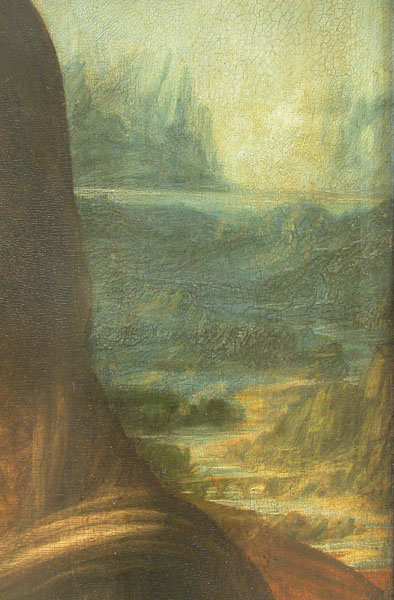
The NYT has a wonderful story on Da Vinci’s Mona Lisa.

Prado researcher Ana Gonzalez has definitively shown that the Museum’s copy of the masterpiece was created side by side and step by step along with the original. Read the piece here to see how the truth was uncovered under layers of paint and time.

We study the painting every year in my Humanities course. The story reminded me how “layers” captures something essential about this work. And it got me thinking about “layers” in a larger sense.

First, in the case of the Mona Lisa, came the layers of paint laid down by Leonardo himself: an underlying sketch,  fields of color and shading over the sketch, features and details in finer brushwork on top of that and finally, in exquisite detail and delicate hand, finishing touches bringing lace, lips and landscape shimmeringly to life. Even after initially completing the piece, Leonardo added layers of alterations over many years: a slightly smaller head, a slimmed bosom, a lowered bodice.

And this was actually the decisive factor in Gonzalez’ detective work: even covered layers of alterations were a perfect match. There can be no other explanation: whoever was doing the copying was always sitting right there at the master’s side, over many years, as he refined the painting. The copy has recently been cleaned, unlike the original covered with still more layers of varnish and paint added by subsequent collectors.  It reveals not only stunning new detail and virtuosity but a younger Mona Lisa. Though the scholarly world does claim the copier was always the same person, they have  no idea who Leonardo’s partner was, and will likely never know.

But that’s just one of the many “layers” of mystery in the work:

To what territory does the surreal background landscape refer?

Why did Leonardo keep this painting with him until his death?

And, of course, why that enigmatic half-smile?

Wendy Beckett, the Benedictine nun turned internationally celebrated art critic, has an intriguing interpretation of the painting in her film series.

She says that the woman sitting for the painting, La Gioconda wife of Francesco Giocondo (rough translation: “Mrs. Happiness, wife of Mr. Francis Happiness”) is looking at Leonardo, not at us, and saying: “You and I share a secret and neither of us is telling.”

It is widely believed that Leonardo was a homosexual. Is that the secret? If the copier was painting, too, it might have added another layer to what she knew.

Many scholars believe that Leonardo was ultimately painting himself. Note the strong jaw line. Is that the secret? Did Lady Happiness know this secret? Did his partner?

My first encounter with Leonardo Da Vinci was through my Dad. He’d drawn an aerial view of our backyard to plan the placement of a backboard and hoop. I was fascinated with the clean lines of the drawing: the yard and fence in perspective, shrubs sketched in a corner, even the figure of a boy standing under the yet-to-be-raised standard.

“How did you do that? I asked him.

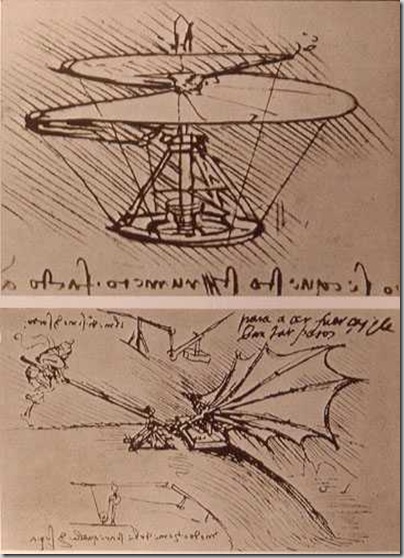
“I’m engineer; I learned it in school. Let me show you the drawings of  the greatest engineer that ever lived.” He got out the encyclopedia and showed me black and white sketches like these.

He was a helicopter engineer so he told me the story of how Da Vinci had designed one 500 years before Igor Sikorski actually made one that flew.

“All he was missing was a source of propulsion,” Dad said.

I noticed Da Vinci’s drawings had the same sharp, diagonal lines to create depth that my Dad had used for the backyard.

I already had a kind of reverence for things my Dad knew how to do.

That day the name “Leonardo Da Vinci” was added to my personal hall of saints.

And so here I am years later,  teaching Leonardo. Reading the latest about Leonardo. And realizing today, on his birthday as it happens, that I know almost nothing of Leonardo Da Vinci, the human being.

What does it really capture in terms of the essence of a person to call them a homosexual or an engineer or an artist? Or even to gaze in speculation and surmise upon the immediate work of their hands miraculously expressing something of the spirit of the person and nevertheless leaving so much concealed in mystery?

Time and layers of dirt will cover us all.  But today, now, at this moment in all of its overwhelming complexity, immediacy and endless mystery, we are here. We are present to ourselves and to one another as Leonardo was, underneath the layers of paint and time,  to Lady Happiness and his Prado Partner.  As I was to my father. Somehow, miraculously, we are present to it all as it passes away. And it is present to us.  The inexhaustible mystery.

« Newer Posts - Older Posts »

Categories