Posted by: cctracker | January 29, 2012

Born to… Persistence Hunt?

Evolutionary biologists make a good case that we were “born to run.” In fact, they say we are the best long-distance running animal on the planet. For many thousands of years we made our living running down the animals we needed to eat by simply pursuing them until they were utterly exhausted. Our limbs, lungs and brains still remember how it’s done. They call it “persistence hunting.”

To see what it looks like on the African Savannah, David Attenborough narrates a great film here.

But if you’d like to try it at home, go outside and get off the pavement.  Find a trail through the woods–or at least a gravel trail as I did today–and a natural landscape to engage the eye. Run slowly, but tall and alert. Run as if you were barefoot, your toes and arches taking up most of the load with your heels striking lightly. Let your eyes dart from trees to ground to horizon, focussing on anything that catches your eye. Watch for the tracks of your prey on the ground, and ankle-busting holes for that matter. Glide along. Settle in as if for a day-long run. There’s no hurry. If you keep your eyes open and keep going, the odds might be on your side. And you just might feel as if  you’ve found your niche.

Photo by Brian Gilmore

Posted by: cctracker | January 20, 2012

Signs of the Times: Modesty Evolved and Revealed

The Ten Commandments, In SVG

Image via Wikipedia

What are we to think when, in the name of religion,  grown men spit on a modestly dressed 8-year old girl as she walks to a religious school? And what if she is a member of their own religious tradition?

In today’s NY Times Rabbi Dov Linzer presents an illuminating scriptural perspective on “modesty.”  He  gets to the spiritual core of what it really asks of us and to whom the challenge is really addressed. But an evolutionary and scientific perspective on modesty may help make sense of the moral blindness and outrageous cruelty we see in so many cultures. Understanding the depths of both the revealed and the evolutionary truths of a subject like this is vital work for thinking people who want to draw on both for wisdom and guidance.

Link to the column here.

Where does evolutionary reflection on “Modesty” lead? And why bother?

Talking about modesty from the perspective of culture, politics or religion would seem difficult enough: so many layers of meaning to acknowledge, so many threads of individual and communal responsibility to trace within the whole fabric of global and communal life.

Rabbi Linzer argues that the ultra-Othordox men who spit on Naama Margolese have perverted the very soul of modesty. While the sanctity of every person is at the heart of the Torah, these men, at least under certain circumstances, see women as mere objects to be controlled because they stir up mens’ desires. As for the Talmud, Linzer says it declares that men ought to control themselves! He ends the article with this masterful flourish of scriptural theology  and rhetoric:

“Jewish tradition teaches men and women alike that they should be modest in their dress. But modesty is not defined by, or even primarily about, how much of one’s body is covered. It is about comportment and behavior. It is about recognizing that one need not be the center of attention. It is about embodying the prophet Micah’s call for modesty: learning “to walk humbly with your God.” 

This is good apologetics. And it delivers a powerful and simple spiritual challenge. But however affecting, we are familiar with the approach. And while we might agree with him, we anticipate the flak:

“Then why don’t these orthodox old men see it that way ?”

“If religion has to work mental gymnastics with its texts and traditions just to affirm common decency it isn’t worth paying attention to in the first place.”

“He’s missed the point. It’s really all just politics.”

Evolution may offer us another angle and send us back into our traditions with a fresh challenge.

What if we consider the possibility that the behavior of these men, conducted in the name of modesty–as far as their conscious awareness is concerned in the name of God–is actually better understood biologically? What is the best way to understand the emotions of anger and disgust these men feel as they spit and hurl insults at a small girl?

If we call it “hatred” we’ve just used another word, like “evil,” to label it. If we blame religion we haven’t explained why the very same pattern of emotions and behavior can be found in in social contexts where religion is absent.We could say “ignorance,” but we’d have to clarify: ignorant of what? The humane and transcendent  message of truth from scripture and tradition? That leads to another question: then why are they blind to that message? Have they chosen to be blind or has someone or something blinded them?

Unlike the familiar, if compelling, way we hear Linzer’s words, the message from those using evolution and socio-biology to explain the inner life and behavior of human beings is fearful and strange for most of us:
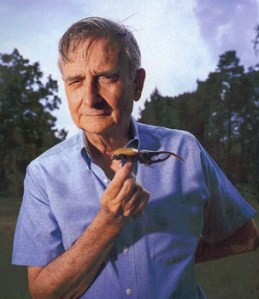
Naturalist and Sociobiologist Edward O. Wilson

These emotions and behaviors are the product of millions of years of biological evolution and thousands of years of social evolution built on biology. Anger and disgust evolved to attach themselves to what threatens the individual or the group. The cultural artifacts, abstract concepts and behaviors that have gathered around the term “modesty” are, though unimaginably complex, still products of the same process, designed by the “blind” mechanics of nature to serve the thriving of the individual and the group.

So what is threatened by an 8-year old girl’s alternative style of dress?

At one level, the men’s authority, their status in the collective. At a deeper level, the coherence of communal symbols that define the group’s distinct identity. But what it really comes down to, as is so often the case in evolution, is sex. Rich and stable human culture has evolved on the scaffolding of  lineage and clan; traditions that enforce modesty protect them from the chaotic force of our sexual drive. Men are viscerally compelled to protect  from outsiders the wombs from which their offspring will come.

An elder doesn’t have to be conscious of any of this for it to be true. In an evolutionary view, Naama Margolese is a victim not so much of his intentions as of her circumstances. Her pattern of unimaginably complex sociobiological life happens to conflict with his. And deep-seated emotions, with their associated symbols, behaviors and ideas, have evolved to make him feel as if this little patch of sidewalk isn’t big enough for the both of them.

But doesn’t this narrative itself threaten us all? How do we ground our stand against this behavior? Where is the place for human freedom in it? Or more to the point, moral responsibility?

Modesty

“Modesty” Image by pixelsandpaper via Flickr

I remember another story  about modesty that ran a number of years ago in the Times. United nations General Secretary Ban Ki Moon was describing a moment early in his adolescence when he first glimpsed a beautiful woman in what was for him rather revealing western dress. His Korean culture had implanted modesty deep within him: not only was it improper to consume the beauty of a woman with your eyes,  it was not even allowed for a young man to meet the gaze of an unmarried woman not in your family. He described helpless and panicked feelings colliding within him as the young woman boldly invited his gaze. He was paralyzed. He couldn’t look, but he couldn’t bear to look away.

When I read the story, something stirred in me. All at once, I vividly recalled my own dark and confused interior battle with these same forces. On the one hand I was very normal: endlessly fascinated with the way women looked, moved, talked. But–and I’ve still not fully explored the cultural origins of how this came to be–I was a very modest boy. It’s too long a story to tell here, but it has something to do with the religious formation I had as a child. I was taught in a very explicit, imaginative and, I can say now, mystical way to see every person as if they were Jesus. Gazing at a girl or woman to purposely feed my curiosity and desire felt  viscerally wrong to me. As if I were taking something from her. As if I were using her without any regard for who she was for herself.


I was   thinking about all of this on Sunday afternoon as I listened to PRI’s To The Best  of Our Knowledge. The hour was focussed on “Medicine and Compassion.” James Orbinski  of Doctors Without Borders was interviewed about his experience in Rawanda just after the genocide.

Listen to the segment here.

He describes the only moment that made him wretch in the midst of  all the suffering and horrific trauma he had witnessed. He was trying to close the wounds of a young woman who had both of her ears cut off. Her face had been systematically flayed open with deliberate, horizontal cuts to maximize her disfigurement. He vomited in disgust from the sheer intentionality of the act against her rather than horror of the wounds.

But when he turned back to her afterward to continue closing her wounds, her hands reached out to touch him, to comfort and reassure him, to care for him in his suffering. She understood how difficult her suffering was for him to endure. Some time later, when he couldn’t bear to move on to the next patient, it was she who urged him to leave her side, to get on with his work. He never saw her again, but he said that moment revealed to him more to him than any other about the depths of the human potential for compassion. When the interviewer asked him if, after all that he had seen, he was still a spiritual person, his answer was “yes.”

James Orbinski of Doctors Without Borders

How should we understand Orbinski’s disgust?  Or his patient’s compassion?  What can we say about the origins of these emotions? How shall we name the source from which they come? Does evolution say enough? It declares that all that is has come to be is the result of material processes we can understand, measure and explain. If we accept that modesty has, like our thumbs, evolved is there anything else we need to say?

Yes. It is crucial, it seems to me, to say that there is something very different going on within the hearts of the men who spit on Naama Margolese from what is going on within the soul of James Orbinski. It is morally and intellectually wrong to say simply that evolution has lead the orthodox men to one place and Orbinski to another. I believe it is also bad science. Human biological and cultural life have indeed evolved, but the astonishing, conscious and miraculously generous expression of love and compassion Orbinski encountered is, for want of a better word, “new.”

Revelation literally means that which has been revealed. It names that which human beings have discovered, encountered and received, not that which we have manufactured, created or imagined for ourselves. To say that a truth is “revealed” is to say that it transcends us, that it is true without needing us to make it so. Our posture toward revealed truths, therefore, ought to be humility, and for the religious person reverence, before that which is.

The best expression I have ever encountered for what the revealed virtue of modesty is comes from my own spiritual tradition, in this case From Pope John Paul II, but I believe that it can be affirmed just as well by those who humbly embrace the work of science:
Modesty is the humility of the body toward the greatness of the person.”
When the virtue of modesty breaks through to this level, “creation,” so marvelously evolved through the endlessly complex and even brutal chapters of evolution, is “made new.” The spiritual identity of human beings has been revealed. It has been called forth from the flesh. And it holds all who come upon it in heart and mind to account.

Photo by James Burton

Posted by: cctracker | January 17, 2012

Descendants in an Ocean of Water-Lilies

Saturday I visited an exhibit featuring a triptych of Monet’s Water-Lilies and then Sunday went to see Alexander Payne’s new movie The Descendants. Both stayed with me and  came to feel like two parts of the same event. As sensory experiences there were striking similarities, but there was also an underlying message for me in both. I had a hard time putting that “message” into words so I thought I’d give it a try here.

Both experiences were “oceanic.” The exhibit and the film enveloped me in sensory impressions: light, color, air–even humidity. Monet’s paintings, keeping with his original request, were framed in beautiful, golden oak wood frames. But I felt vertigo staring at them. It was as if the floor had fallen away and I was being drawn in to the small, intimate pond at Giverny which somehow had no frame, no banks at all.

Though composed on a completely different visual scale, The Descendants felt the same way. The movie fills the screen with gauzy, humid color: shrub walls and flower beds loom in foregrounds while grassy  fields, cloud-laden skies skimming rocky peaks and hazy ocean vistas recede  to an indistinct horizon. The land and the water are characters in the movie, foreshadowing the ending from the earliest frames and exerting such a palpable influence that my skin felt clammy and my nose knew how blossoms would smell in sea air.

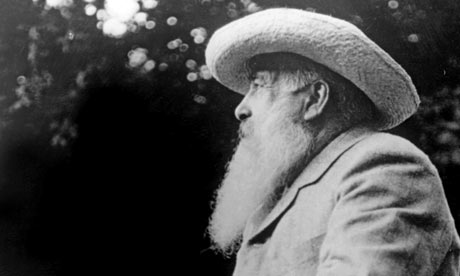
But the “message” only came into focus for me when I considered the human characters against these landscapes. Monet, in the exhibit’s grainy black and white film, flourishes a brush on a huge canvas with pond and willows in the background. George Clooney’s character and his wounded rag-tag  family  drive, walk and hike against a background of Hawaiian boulevards, neighborhoods, upscale developments and native landscapes.

Losing myself, as millions have, in the shimmering images of The Water-Lilies, I was nevertheless aware that Monet himself is gone and that many  generations will pass before this work and withdraw, unknown to me and one another while the work itself remains. Acknowledging and affirming that felt like the proper spiritual posture for standing there.

For Clooney’s character the painful acceptance not only of his wife’s death but of his enduring love for her despite her betrayal, is accompanied by the acceptance of a truth he encounters in the sweeping slope of his family’s land and in the silence of  the black and white photos of his ancestors: we do not remain; only what we release and pass along can endure.

I think it was Freud who used the term “oceanic” to critique religion, declaring that it seeks to recreate the infantile illusion of the  enveloping security of the womb. For me, enveloped by the ocean of Monet’s pond and Payne’s Hawaiian canvas of love and loss, I found the same invitation to a generous free and adult interior life that I have encountered at the heart of the world’s great religions: “Come fully into the presence of that which is larger than you, that which transcends you. Honor it with the creativity and generosity of your own immeasurable, yet mortal, life. And then, with love, release it.”

Posted by: cctracker | January 13, 2012

A Sudden Cabin in the Woods

Friday night. Last night at home for the youngest college boy. My wife cooked dinner. No TV or music on. For a friday night that was unusual. After dinner she asked for a fire. I’d prepared the wood earlier and it  roared to life in seconds. I’d stoked it with lots of twigs. The logs really need another year before they’re seasoned and they need intense heat to catch. The extra kindling worked and in a few minutes the fire settled down for a long, mellow burn. The three of us sat there together in silence, reading books.  The only sounds were the  sizzle and pop of the modest fire and the intermittent, low rumble of the furnace.

I’m just starting The Last Child in the Woods. As I put my feet up on the hearth, I realized that though moments like this were available almost any night, I’d never had one quite like it. Suddenly, we were living together in a cabin in the woods.

Posted by: cctracker | January 11, 2012

Wisdom, Plain-Spoken

Photo by James Burton

Stltoday/ St. Louis Post-Dispatch columnist Bill McClellan seems like the last of the old newspaper men.  A rumpled, straight-talker with a Chicago accent drawn to the plight of ordinary folk, he nevertheless often gets to profound territory. His topic is “awareness” in this piece, but he takes us there in a way that will catch any reader.  Here are the first few lines:

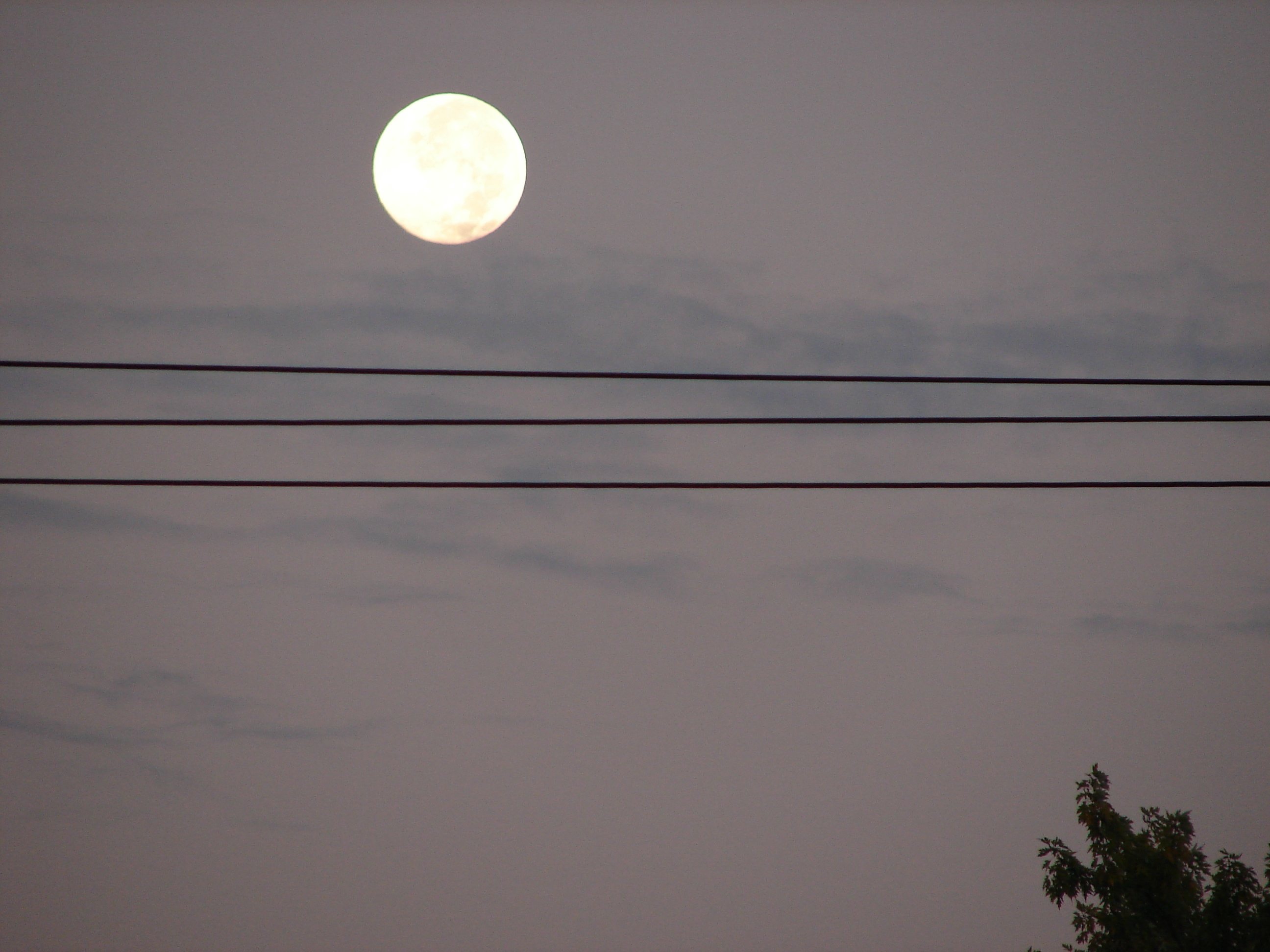
“Do you know what phase the moon is in right now? It’s up there every night.

Even though we can’t see the stars too well any more, the moon is still clearly visible. If you looked at it last night, you’d know what phase it’s in.

A lot of us hardly ever look up.

I thought about that over the holidays. I was in Nicaragua, and I spent some time out in the country where it still gets dark at night. The stars were fantastic. When you see stars like that, you can understand why earlier civilizations were fascinated by the night sky.

We’re not. For the most part, there’s not much to see if you live anywhere near a city.

But the moon, big as it is, how can we miss it?

We miss a lot of things. Can you name every family that lives on your block?

When I was a kid, I could. In fact, I can still recall those families. For the most part, I can remember the occupations of most of the men. Bear in mind, too, that this was a time before neighborhood associations. There were no organized activities. People just knew about their neighbors…”

Take a look at the rest of what he says on that “neighborhood” theme. He goes on to talk about how we’re becoming “oblivious to things” and even speculates about our evolution on the savannah!  He may be a vanishing breed, but here’s hoping his descendants in the business will keep finding ways to open up the soulfulness of ordinary life for readers.

The rest of the column can be found here.

Posted by: cctracker | January 8, 2012

Signs of the Times

Long before scanning nytimes.com several times a day was a part of my routine, I loved the New York Times. When I was a younger man, buying my own copy (usually at the airport) and wading into stories that pulled me down into the depths of an issue or transported me to another time and place was one of my favorite, non-guilt-inducing pleasures. It was like sitting down to a sumptuous, four-course dinner: each piece offered a more nuanced and complex set of flavors and textures than the one before. I tore out stories and added them to a stack on a top shelf in my office, compressing over the years like layers of limestone. I still fantasize about annotating and filing them all according to themes for future essays.

I’m a weekend subscriber now–at the educator’s rate– and I take the Times for granted a bit. For one, it isn’t the paper it used to be. But I also have to confess I’ve noticed a diminution of the will and discipline required for savoring and digesting those wonderful, long stories. It feels, at least in part, like a consequence of too much scanning. “I’ll tackle that one later,” I say to myself, “when I have more time.” I don’t need to tell you what happens in so many of those cases.

But the romance isn’t over. What I want to do every so often in these posts is share some reflections on NY Times stories that stir something up in me that connects to the theme of this blog. I’ll post them as “Signs of the Times” echoing one of my favorite phrases emerging from the second Vatican Council.

Here’s a piece that ran in today’s edition:

It tells the story of Lakhdar Boumediene. He was imprisoned while working for the Red Crescent Society of the United Arab Emirates in Bosnia-Herzegovinia October of 2001 . On May 15, 2009 he was finally released from the American prison for terrorist suspects at Guantanamo Bay Cuba. He had missed the entire childhood of his two daughters.

He was accused of planning to bomb the embassy in Sarajevo, but was never presented with a shred of evidence. You can read the by now too-familiar story of  years of force-feeding and “stress positions” while he maintained his innocence. It is also a story of the eventual victory, at least in his case, of the core principles of the American justice system. At the last minute, just before his case was coming before a judge, the government abandoned its case about the alleged bomb plot.

But what lingered in my mind after reading it was a subject I’ve considered countless times when I encounter stories of this kind: the horror of the forced confession. What must it be like to be in such a position? To know that you are innocent but to know at the same time that your only path to temporary relief from the seemingly endless brutality of your circumstances is to admit that you are guilty. Even more to the point: What is it like–interiorly from the perspective of self-consciousness and self-appraisal– to be the instrument of such a system: the interrogator, the warden, the policy bureaucrat?

The sacred and inviolable character of an individual human life is at the center of nearly every secular and religious moral system. A large majority of the people on the planet are taught some version of this truth. Whatever one thinks of the failures of the West and the United States in the pages of history, our tradition has enshrined this principle more clearly and publicly than any other tradition in its founding documents and rhetoric.

And yet, here it is: as bald and inexcusable as it would be in any of the stereotypically morally bankrupt societies from which we hope to distinguish ourselves. Here is the horror of the community, the collective organism, utterly abandoning the sacred truth that has emerged from thousands of years of  evolved wisdom about how we ought to conduct ourselves. Boumediene’s captors already had the answers they wanted from him. He did not exist for them but as a thing, an object to be used.

What I’ve come to realize is that while I still affirm and even revere the moral perspective that holds to account before God and conscience every individual in the chain of command that lead to Boumediene’s abuse, there is an accompanying, and less comforting perspective, a more “scientific” perspective, I must also embrace.  If I want to comprehend these events, if I really want to know what goes on the hearts of those who enact them, I have to see biology at work here. I have to see social structures with evolutionary utility at work. I have to be willing to consider that many of those who ask the questions, tighten the bindings and write the phony reports have clear consciences. In an interior sense, they’ve partially vanished as individuals along with Boumediene. They, too, are being “used.” And not simply by a nefarious, crazed culture of super-villains, but by something incredibly complex, something blind and embedded in the very nature of being a social animal.

The culture of a community can surround and penetrate individual consciousness to such a degree that when the group perceives itself as threatened or faced with an urgent task that serves its own survival, it acts, in a powerful process of neurological commissioning, to direct individual members of the group to do its bidding and to feel right about it.

The generic name we’ve given to phenomena like this is “instinct.”  It goes by many names in spiritual traditions.  My own places it under the increasingly opaque banner of  “original sin.”  We are “fallen” creatures, still under the tyrannical regime of sin that would blind us to our own–and everyone else’s– inestimable and transcendent worth and would turn human beings into mere things to be used.

But  our communal and spiritual inheritance of  faith is as alive and as real as our inheritance of instinct!  Something new has emerged, something remarkable has evolved, even if it is as weak and vulnerable as a child. It is captured in secular documents like the The United Nations’ Declaration on Human Rights. It is enshrined in the Constitution of the United States. And for Christians,  it is at the heart of the Gospels.

“Lakhdar Boumediene is a human being. He must never be used, no matter the cause or the stakes of the contest.”

“Jesus Christ is Lord.”

If we cannot see the unity of these two statements and if we do not proclaim them both at once,  the dawn of  the “new creation” for which all people have been waiting, can never evolve.

photo James Burton


Posted by: cctracker | January 2, 2012

On Questions

My uncle died a few days ago as a result of a terrible automobile accident. He was over 80, but healthy, active and looking forward to years of vitality. I sat in my folks’ living room New Year’s Day talking it over with my Dad.  “I was sitting at Mass today and couldn’t get him off of my mind,” he said. “It could be any of us any time, you know?” He hesitated a moment. He’s 78 and I knew he was thinking about his own mortality. He swallowed the emotion back and continued: “What if there’s nothing else?” After another longer pause he finished the thought: “You know, I don’t think it really changes anything.”

My Dad is a devout Catholic. Teaches adult converts, reads the scriptures, prays daily. He hungers and thirsts for justice and is a model of spiritual authenticity for me. But he’s also a model of truth-telling and humility. He’s never had any room for room for pretense or, as he used to call it as a  younger man: “bullshit.”

As I sat there listening to him go to such a raw, honest and vulnerable spiritual place, I found myself realizing again how vital real questions are in the spiritual life. We didn’t talk much beyond that conversation, but I saw how that question allowed him to get to a place of real poverty before the mystery of life and death.

Whatever our claims about the afterlife, they are not really anything we possess. We have no idea, really, what we’re talking about. The meaning and weight of our individual lives–of life itself– extends beyond our ability for keeping and comprehension.  Poor before these mysteries, perhaps we can be properly reverent about them, properly devotional.

So beginning this enterprise in a new year, I turn to the questions that were a significant part of why I began a blog. I hope to proceed with the kind of  faith my Dad has modeled for me. May the poverty of these open questions be a doorway to both deeper authenticity and deeper devotion.

Here are a few of the questions I’d like to reflect upon in the months ahead:

Can a posture of traditional faith be authentically reconciled with the profound human experiences and intuitions of randomness, meaninglessness, harshness, waste and emptiness?

What are the right interior, intellectual and spiritual postures to assume given the basic insight of evolution: that every design, every function of living things emerges from the utility of  adaptations ultimately driven by random selection? Interiorizing this perspective seems to lead inexorably to discounting the reality–and perhaps the value–of interiority itself.

Given the nature of our species and the vectors of history and current trends, where is the accelerating pace of technological change leading us a species?  Where are the greatest threats? The greatest opportunities?  What practical, philosophical and spiritual tools can guide us not only in coping with these changes, but in channeling them toward authentic individual, communal and global thriving?

Of course these are the fancy, academic ways to put these questions. I might just as well have asked questions like these:

Why does my new iphone 4s make me so nervous?

Why am I stirred to my depths by birdsong?

What lessons and truths does the unspeakable love I have for my wife and my children have to teach me?

Posted by: cctracker | December 31, 2011

Christmas Hope

A few years ago our high-school newspaper asked members of the faculty to share a few brief thoughts on what gave them hope at Christmas.

Last week, a friend was kind enough to  share that one of the alum editors had kept my comments and shared them with his family before dinner this year. He was good enough to send me the words I’d composed in an e-mail and hadn’t otherwise saved. They still feel true and they still hold me to account:

“If I only have a few sentences to say where I find hope, I’d say I find it most in the generosity of human beings I encounter. Not just in the “generosity” of seeing someone intentionally share something with someone else, but in the underlying generosity that allows them to give themselves to the world in the first place, to let others see their true colors, hear their real voice. I’ll sometimes find myself thinking of a particular person—my niece, my wife, an athlete I’ve coached, a singer/songwriter I like—and I feel a joy well up in me, a thrill. “This person is alive!” I feel myself almost shouting aloud. They are giving themselves and I’ve been lucky enough to be there to experience it. And so, I am filled with hope, an inexpressible sense that continuing to take the risk of giving myself, in spite of all that can and does go wrong, is absolutely the right thing to do. To me, affirming the importance of that generosity—that “pouring out” of one’s self—is very closely associated with what it means to have faith in God, to believe the “good news” that Jesus taught.

The word “hope” itself indirectly acknowledges a problem. The experiences we desire most deeply in life—love, joy, meaning and fulfillment—don’t come automatically for us or those around us. Fundamental things about life get in the way: the experiences of loss, loneliness, violence, and vulnerability to forces we can’t control, the inevitability of death. Eventually, as mature adults, we come to see that these things will never go away. Under these very difficult physical, psychological and spiritual circumstances we have to figure out whether or how we can keep pursuing those deep desires. The term “God”—and many other terms in other languages and traditions—has served as a placeholder for the deeply felt experience that we keep going not only by our own efforts or by solving the problem of existence with our own minds, but by somehow being OPEN to a gift that is larger than ourselves. “God” is the name we’ve given to the source for that gift, that hope. I’d say we are in a period of human history in which the term “God” feels small and irrelevant to more and more people who have mistaken it either for something we human beings made up to solve our problems or for something completely beyond us that might as well be appealed to through magic. Instead, Christianity makes the claim that life (faith, hope, love: the terms all point to the same inexpressible reality) is a GIFT. It is simply GIVEN. And it is best accepted by learning to become a gift one’s self, by pouring one’s self out for all the world to see as God has done in Jesus, as he has done for me in the people I mentioned above and as he wants to do in each of us. That, I think, is what Christmas is all about.”

Posted by: cctracker | December 30, 2011

Awareness, Humility and Gratitude

This warm winter morning at the end of the year has an undefinable quality I have loved my whole life. Sunlight and clouds tumble together through a brilliant, blue sky. Surging winds roar, rocking clean, bud-knobbed tree branches back and forth. Winds subside, then rise again, wicking rain off the streets, up out of damp garden beds and lawns into my face, carrying a faint trace of what my open pores call “spring!”  My mind measures the long months from here to March, but the insistent “wheet-wheet-wheet!” of a Tufted Titmouse, as primitive and forceful for me as Stravinsky or the sound of the wind itself, stirs up yearning for  spring, nevertheless.

I put the yearning aside gladly. I will not cheat myself of the melancholy  drama of February.

I begin this project with hope that I can aspire with integrity  to this first banner. In many years of thinking about how to talk about our interior experience of the world around us–and of our experience of our own consciouness–these three words have offered themselves more and more as fundamental and helpful in the task.

It makes sense to begin this conversation with “awareness.” We are ravenous for experience and knowledge as a species before we even know we know. Once we do, the thrill of discovery and the desire for knowledge  become intoxicating. For a time, at least, we cannot resist. “Awareness,” as I hope to share in future posts, is also a personal place to begin for me. Nearly 20 years ago I took the word up again, and, with apologies for the cliche’, considered it again as if for the first time.

“Humility,” is my most fervent prayer, not only because it offers a virtuous way to respond to the profound shock of our weakness and limitation before the vastness of all that is, but also because it has offered practical protection from the most toxic threats to my own interior life.

Finally, “gratitude,”  if steadily cultivated, grounds every experience in a spirit of “unguardedness” and cooperation. Everything, upon reflection, is “given,” whether we choose to direct our thoughts to a source or not. We are infinitesimal yet wondrous conduits for all that is, but we are not the source. Authentic creativity, truly productive agency in this life we are given, seems to depend upon grasping this truth.

So I’m grateful to you for stopping here to consider these reflections on the interior dimensions our experience of nature, culture and technology. I welcome the opportunity to join you in this and other conversations.

« Newer Posts

Categories